| 46 | B A L D W I N L O C O M O T I V E S |
|
|
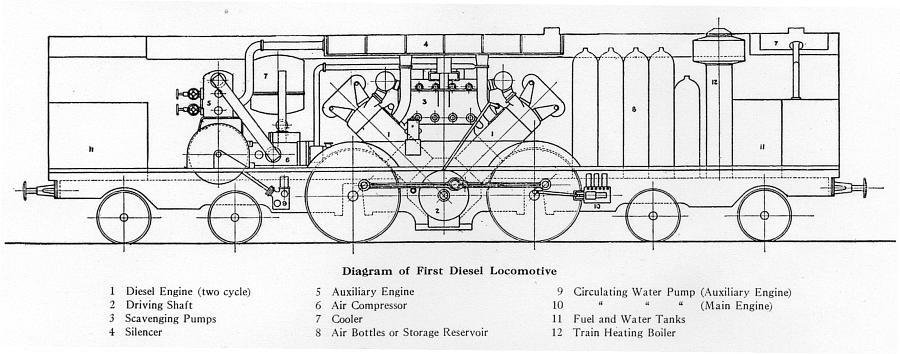
| As shown by the diagram, it was of the 4-4-4 type, having two pairs of drivers and four- wheeled trucks for both leading and trailing. Its main motor was of two-cycle, single-acting type with cylinders 15" diameter, by 21 1/2" stroke; suspended in "V" form, longitudinally with the locomotive, and driving a transverse jack-shaft with cranks located at 180 degrees. Not being self-starting, it was equipped with an auxiliary Diesel motor which could develop about 1/4 the power of the main motor; this auxiliary |
3. — Transmission of power by electricity. Each of these systems will be separately described and examples given of locomotives so equipped. Mechanical Transmissions. — These are of the ordinary change-speed, stepped gearing variety as applied in automobile practice; although in locomotive construction they should preferably be arranged to give the same range of speeds both forward and backward. Reversing is usually accomplished by bevel gearing. Mechanical |
 |
|
motor compressing air to a pressure between
600 and 1000 lb. per sq. inch. The air was
stored in a battery of reservoirs and used
for starting both motors. Road tests of this locomotive were made on the Swiss Federal Lines between Winterthur and Romanshorn, and a speed of 62 1/2 miles per hour was attained. Early in 1914, the road tests were transferred to the Berlin-Mansfeld Line of the Prussian State |
transmissions, of course, require some sort
of a friction clutch, and this feature gives
trouble on the upper range of power to
which mechanical transmission is applicable.
It is probable that 150 horse-power is the
practical limit for mechanical transmission. The Winterthur industrial locomotive illustrated below is of true Diesel type and has a four-cycle engine of 100 horse-power; from which power is applied through a |
| Railways. Further record, as before stated, seems to have been lost 'in the hurly-burly of war. Inasmuch as the Diesel (or other internal combustion) engine must be operated at speeds within its range of efficiency, and not at a practically zero start, as in direct connection, the designer must find proper means for connecting the running prime mover to the locomotive driving mechanism. This transfer of power can be accomplished in three ways: |
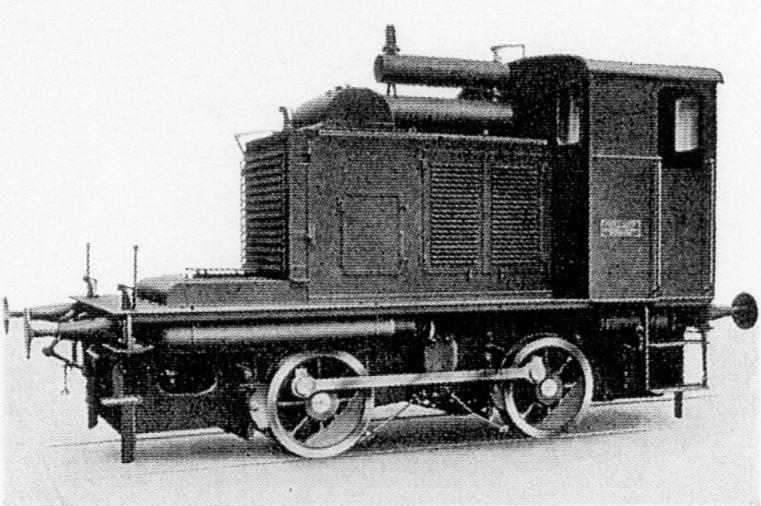 Winterthur Industrial Locomotive |
|
1.—By mechanical (stepped gearing) transmissions. 2.—By hydraulic (fluid pressure) transmissions. |
mechanical transmission of special design originated by the Swiss Locomotive and Machine Works. It is controlled by a |